
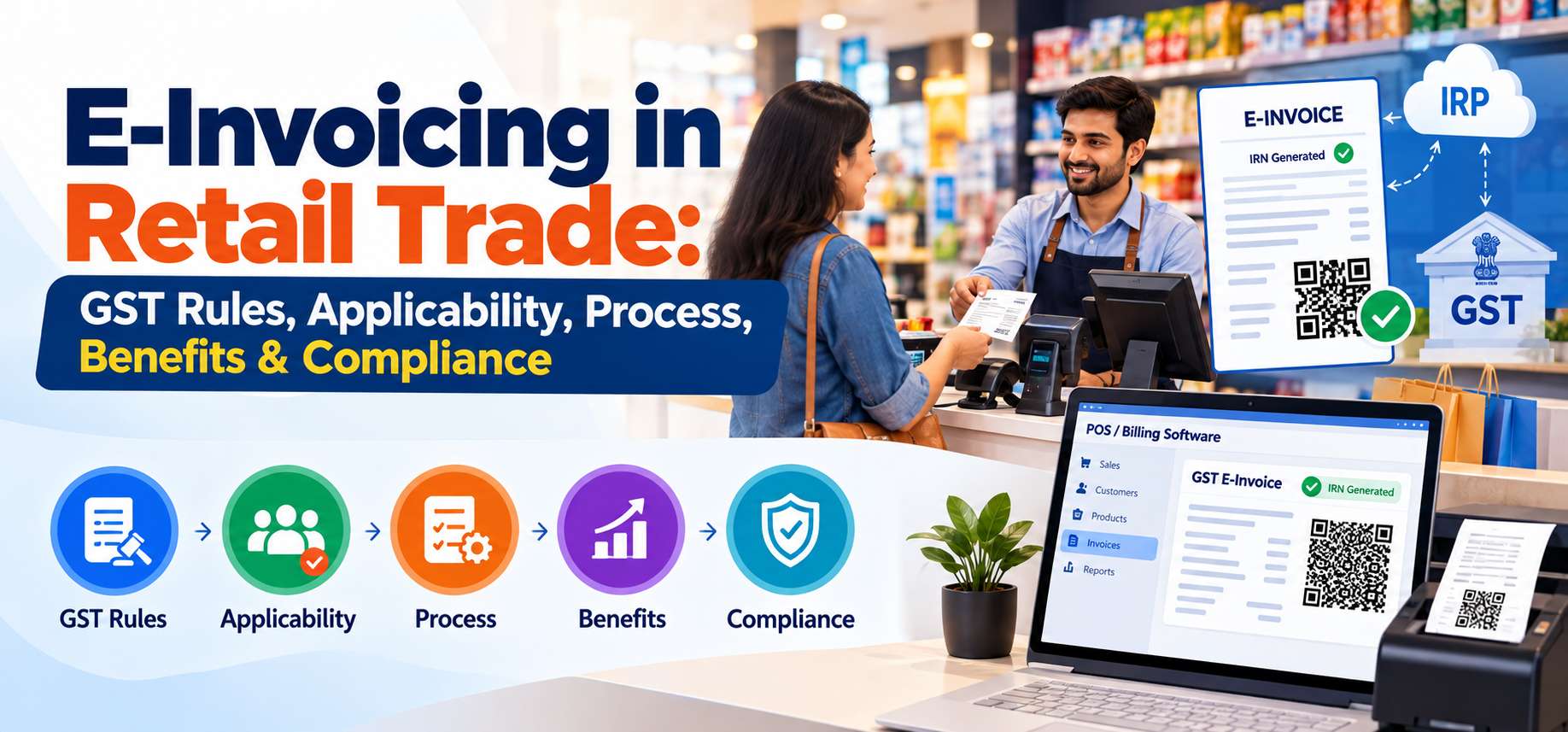
Retail businesses generate a large volume of invoices every day. From supermarkets and electronics stores to apparel retailers, automobile dealers, furniture shops and multi-location retail chains, accurate invoicing is important for GST compliance, inventory management, customer records and business reporting.
With India's GST e-invoicing system, certain businesses must report specified invoices to an Invoice Registration Portal (IRP) and obtain an Invoice Reference Number (IRN) along with a digitally signed QR code.
However, e-invoicing does not mean that every retail sale needs to be registered on the IRP. The applicability depends on factors such as the taxpayer's aggregate annual turnover, transaction type and applicable exemptions.
As of the current GST framework, the e-invoicing threshold is Rs 5 crore or more of Aggregate Annual Turnover (AATO) in any preceding financial year from FY 2017-18 onwards, subject to the applicable rules and exemptions. The threshold was reduced from ?10 crore to ?5 crore with effect from 1 August 2023.
What Is E-Invoicing in Retail Trade?
E-invoicing under GST is a system in which specified GST documents are reported to a government-notified Invoice Registration Portal (IRP) for authentication and generation of an Invoice Reference Number (IRN).
It is important to understand that e-invoicing does not mean that a retailer creates the invoice directly on a government website.
A retailer continues to create the invoice through its:
- POS software
- Billing software
- Accounting software
- ERP
- Retail management system
- Other compatible invoicing systems
The relevant invoice data is then reported to an authorised IRP. After successful validation, the IRP generates the IRN and digitally signed QR code. The e-invoice data is also made available to the GST system for relevant GSTR-1 reporting.
Simple Example
Suppose a retail business has crossed the applicable e-invoicing threshold and sells products worth ?2,00,000 to another GST-registered business.
The retailer creates the invoice in its billing/ERP system:
Invoice → Customer GSTIN → Product Details → HSN → Tax → Total Value
The invoice data is reported to the IRP.
The IRP validates the information and returns:
IRN + Digitally Signed QR Code + Acknowledgement Details
The retailer can then issue the invoice to the buyer with the required e-invoice details.
Is E-Invoicing Mandatory for Retail Businesses?
Not every retail business is required to generate e-invoices.
The key point is that e-invoicing applicability is based primarily on the taxpayer's Aggregate Annual Turnover and the nature of the transaction, along with the notified exclusions.
The current threshold is:
| Particular | Current position |
|---|---|
| E-invoicing threshold | Rs 5 crore AATO or more |
| Threshold basis | Aggregate Annual Turnover |
| Relevant historical period | Any preceding financial year from FY 2017-18 onwards |
| Effective threshold of Rs 5 crore | 1 August 2023 |
| Major applicability | Specified B2B and other notified transactions |
| Portal used | Invoice Registration Portal (IRP) |
| Key output | IRN and digitally signed QR code |
GSTN/IRP guidance states that the Rs 5 crore threshold applies from 1 August 2023.
What Does Aggregate Annual Turnover Mean?
For e-invoicing purposes, the threshold is not simply the turnover of one individual retail outlet.
The relevant turnover is considered at the PAN level, covering the applicable GST registrations of the business across India.
For example, suppose a retail company has:
| GST Registration | Turnover |
|---|---|
| Delhi | Rs 2.2 crore |
| Haryana | Rs 1.8 crore |
| Maharashtra | Rs 1.4 crore |
| Karnataka | Rs 1.0 crore |
| Total | Rs 6.4 crore |
The business crosses the Rs 5 crore threshold based on its aggregate turnover.
Therefore, a retailer should not determine e-invoicing applicability only by looking at the sales of one store or one GSTIN.
Does E-Invoicing Apply to B2C Retail Sales?
This is one of the most important questions for retailers.
A typical retail store may have hundreds or thousands of daily transactions with individual consumers. These are generally B2C transactions, where the buyer is not purchasing as a GST-registered business.
The existing e-invoicing framework primarily covers specified B2B and other notified transaction categories. GSTN's e-invoicing material specifically describes B2B invoices as invoices covered for specified taxpayers based on turnover.
Therefore:
A retailer crossing the e-invoicing threshold should not automatically assume that every normal walk-in B2C bill must be reported to the IRP.
For example:
- Retailer → Individual consumer = generally B2C
- Retailer → GST-registered company = B2B
- Retailer → Registered business customer = B2B
- Retailer → Export customer = export transaction
- Retailer → SEZ customer = SEZ transaction
The treatment depends on the transaction and applicable GST provisions.
Businesses should also monitor GST notifications and advisories because e-invoicing rules can be amended.
Which Retail Transactions Can Require E-Invoicing?
For a retail business covered by the mandate, the following transaction categories can fall within the e-invoicing framework, subject to the applicable rules:
1. B2B Sales
A retailer sells goods to another GST-registered business.
Example:
A consumer electronics retailer sells Rs 5 lakh worth of laptops to a GST-registered company.
The transaction is B2B and can fall under e-invoicing when the supplier is covered by the mandate.
2. Export Invoices
Businesses making notified export supplies can also come within the e-invoicing framework.
GSTN's e-invoicing documentation includes exports, including exports with or without payment of tax, among the relevant transaction categories.
3. Supplies to SEZ
Supplies made to Special Economic Zone entities can also fall within the e-invoice framework where applicable.
4. Deemed Exports
Specified deemed-export transactions can also require e-invoicing for covered taxpayers.
E-Invoice vs Normal Retail Invoice
A common misconception is that an e-invoice is simply a PDF invoice or an invoice containing any QR code.
That is incorrect.
| Normal GST Invoice | E-Invoice |
|---|---|
| Created by seller | Created by seller |
| Can be generated through billing software | Created through billing/ERP software and reported to IRP |
| No IRN required unless covered by mandate | IRN required for covered transactions |
| May contain a normal QR code | IRP-generated digitally signed QR code |
| Not necessarily reported to IRP | Reported to IRP |
| Applicable GST invoice rules apply | Additional e-invoicing requirements apply |
GSTN explains that e-invoicing is the reporting of specified GST documents to the IRP and obtaining an IRN; it is not the generation of an invoice directly by a government portal.
What Is an IRN?
IRN means Invoice Reference Number.
It is a unique reference generated after the invoice details are successfully reported and validated through the IRP.
The IRP also returns a digitally signed QR code along with the IRN.
The QR code contains key invoice information such as:
- Supplier GSTIN
- Recipient GSTIN
- Invoice number
- Invoice date
- Document type
- Invoice value
- HSN information
- IRN
- Other relevant invoice information
How Does E-Invoicing Work in Retail Trade?
The retail e-invoicing process can be understood in the following steps.
Step 1: Retailer Creates Invoice
The retailer generates the invoice using its existing:
POS / ERP / Accounting Software / Billing Software
The system should contain accurate:
- Customer details
- GSTIN
- Product description
- HSN code
- Quantity
- Unit
- Taxable value
- GST rate
- Discount
- Tax amount
- Invoice number
- Invoice date
- Place of supply
Step 2: Invoice Data Is Sent to IRP
The applicable invoice data is reported to an authorised Invoice Registration Portal.
The reporting can be integrated with software through APIs or supported through other available reporting methods.
Step 3: IRP Validates the Invoice
The IRP performs validation checks and helps prevent duplicate reporting.
Step 4: IRN Is Generated
After successful validation, the IRP generates the unique Invoice Reference Number.
Step 5: QR Code Is Generated
The IRP returns a digitally signed QR code associated with the e-invoice.
Step 6: Invoice Is Issued to Buyer
The retailer issues the invoice containing the required e-invoice information.
Step 7: Data Flows to GST System
The e-invoice information is made available for relevant GSTR-1 auto-population.
GSTN states that e-invoice data is auto-populated into relevant GSTR-1 tables, reducing the need for duplicate data entry.
E-Invoicing Process for a Retail Store
A practical retail workflow can look like this:
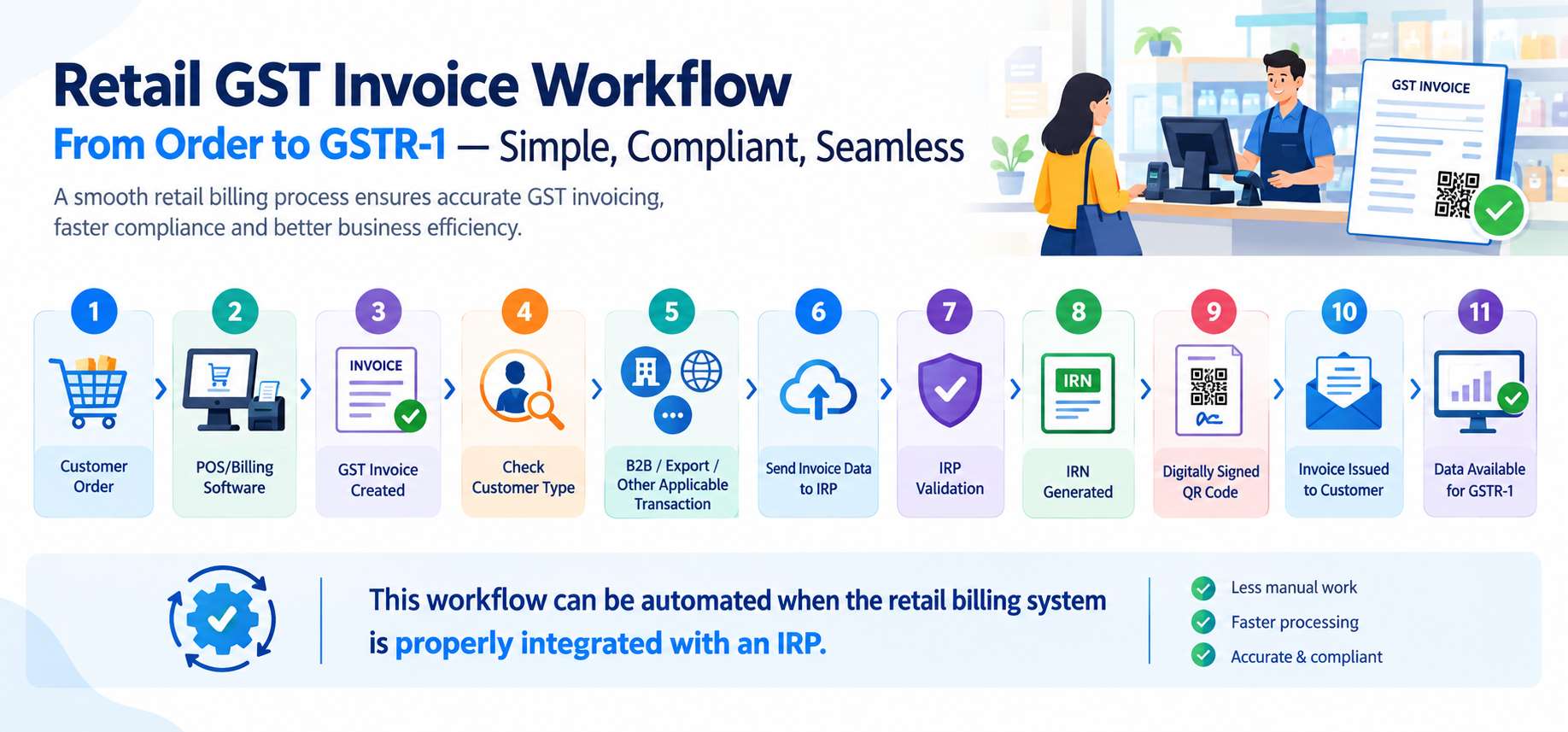
This workflow can be automated when the retail billing system is properly integrated with an IRP.
E-Invoicing and Retail POS Software
For larger retail businesses, manual e-invoice generation can become difficult because of transaction volume.
A POS system connected to an ERP or accounting platform can automate much of the process.
Typical Integration
POS
- → Customer & Product Data
- → Invoice Generation
- → GST Validation
- → IRP API
- → IRN
- → QR Code
- → Final Invoice
- → Accounting
- → GSTR-1 Reconciliation
This type of integration is particularly useful for businesses operating multiple retail outlets.
Important Data Required for Retail E-Invoicing
Retailers should maintain accurate master data.
Business Information
- Legal business name
- GSTIN
- Address
- State code
- Place of supply
Customer Information
For B2B transactions:
- Customer legal name
- Customer GSTIN
- Billing address
- Shipping address
- State code
Product Information
- Product name
- HSN code
- Quantity
- Unit
- Taxable value
- GST rate
- Discount
- Tax amount
Invoice Information
- Invoice number
- Invoice date
- Document type
- Total invoice value
- Payment details where applicable
- Supply type
- Relevant transportation information where required
Incorrect master data can result in invoice rejection or reconciliation problems.
E-Invoice and E-Way Bill: What Is the Difference?
E-invoice and e-way bill are related but different compliance mechanisms.
| E-Invoice | E-Way Bill |
|---|---|
| Focuses on invoice authentication | Focuses on movement of goods |
| Generates IRN | Generates E-Way Bill Number |
| Applies to specified transactions/taxpayers | Applies when e-way bill requirements are triggered |
| Uses IRP | Uses e-way bill system |
| Generates digitally signed QR code | Contains movement/transport details |
| Supports GST invoice reporting | Supports goods movement compliance |
An e-way bill can also be generated along with an e-invoice where the applicable requirements are met. GSTN documentation describes workflows for generating the e-invoice and e-way bill together or generating the e-way bill subsequently using e-invoice information.
E-Invoicing for Multi-Store Retail Chains
Large retailers often have:
- Multiple stores
- Multiple GST registrations
- Central warehouses
- Regional warehouses
- Online sales
- B2B customers
- B2C customers
- Franchise operations
- Multiple billing counters
For such businesses, e-invoicing should be incorporated into the overall billing architecture.
Recommended Structure
Central ERP >> State/GSTIN Master >> Individual Store POS >> Invoice Generation >> Transaction Classification >> IRP Integration >> IRN & QR Code >> Accounting + GST Reconciliation
This structure can reduce manual invoice processing and help maintain consistency between sales, tax and accounting records.
Benefits of E-Invoicing for Retail Businesses
1. Better Invoice Standardisation
E-invoicing uses a standardised schema and reporting process.
This can help businesses maintain consistent invoice information across locations and systems.
2. Reduced Duplicate Data Entry
E-invoice information is used for relevant GSTR-1 auto-population, reducing the need to manually enter the same information again.
3. Better Invoice Verification
The IRN and digitally signed QR code provide a mechanism for verifying e-invoice information.
4. Improved B2B Processing
Retailers supplying businesses can provide invoices with the required IRN and QR code, supporting the buyer's GST documentation and reconciliation process.
5. Better Integration With Accounting Systems
When the POS, ERP and accounting systems are integrated properly, sales and tax information can flow through the business system with fewer manual steps.
6. Easier Reconciliation
Retailers can reconcile:
Sales Register vs E-Invoice Data vs GSTR-1 vs Accounting Records
This is especially useful for high-volume B2B transactions.
7. Better Record Management
Digital invoice data can make searching, filtering and retrieving transaction records easier than maintaining only paper records.
Challenges Retailers May Face With E-Invoicing
E-invoicing also requires changes in retail billing processes.
1. Incorrect GSTIN
A wrong customer GSTIN can result in an incorrect B2B invoice.
2. Incorrect HSN
Product master data should contain the appropriate HSN information.
3. Wrong GST Rate
Incorrect tax rates can create reconciliation and compliance issues.
4. Duplicate Invoice Numbers
Invoice numbering should be controlled carefully.
5. POS-ERP Mismatch
If store-level POS systems and the central ERP do not synchronise correctly, invoice records can become inconsistent.
6. API or Connectivity Problems
Businesses using API-based integration need appropriate error handling and retry processes.
7. Staff Training
Billing staff should understand the difference between B2B and B2C customers and know when GSTIN details are required.
30-Day Reporting Rule for Certain Taxpayers
A significant recent compliance requirement applies to taxpayers with AATO of ?10 crore or more.
From 1 April 2025, taxpayers with AATO of ?10 crore and above must report applicable e-invoices within 30 days from the invoice date. The restriction covers invoices, credit notes and debit notes. The IRP system can reject reporting beyond the permitted 30-day period.
This means large retail businesses should not treat e-invoice reporting as an activity that can always be postponed until the end of the month.
Example
Invoice date:
1 September
Maximum reporting period under the 30-day rule:
Within 30 days from 1 September
Therefore, businesses in this category should build timely IRP reporting into their billing workflow.
Common E-Invoicing Mistakes in Retail Trade
Mistake 1: Assuming Every Retail Bill Needs an IRN
Normal B2C retail sales should not automatically be treated as e-invoices merely because the retailer has crossed the turnover threshold.
Mistake 2: Treating a PDF as an E-Invoice
A PDF invoice without the required IRN and IRP-generated QR code is not the same thing as an e-invoice for a transaction covered by the mandate.
Mistake 3: Entering an Incorrect GSTIN
For B2B transactions, customer GSTIN accuracy is essential.
Mistake 4: Ignoring PAN-Level Turnover
A retailer with multiple GST registrations should consider aggregate turnover rather than evaluating each outlet independently.
Mistake 5: Incorrect HSN or Tax Rate
Product master data should be reviewed regularly.
Mistake 6: Manual Data Entry for High-Volume Retail
For a large retail chain, manual invoice reporting increases operational workload and the risk of errors.
Mistake 7: Ignoring Credit and Debit Notes
Applicable credit and debit notes also need appropriate treatment under the e-invoicing framework.
Mistake 8: Delaying E-Invoice Reporting
Businesses covered by the 30-day reporting restriction should build timely reporting into their billing process.
How Retailers Can Prepare for E-Invoicing
A retailer preparing for e-invoicing can follow this checklist.
Step 1: Check Turnover
Determine whether the business crossed the applicable AATO threshold in any relevant preceding financial year.
Step 2: Check GSTIN Enablement
Check the e-invoicing enablement status of the applicable GSTINs.
Step 3: Identify Transaction Types
Separate:
- B2B
- B2C
- Export
- SEZ
- Deemed export
- Other applicable categories
Step 4: Clean Customer Master Data
Verify:
- GSTIN
- Legal name
- State
- Address
- Place of supply
Step 5: Clean Product Master Data
Verify:
- HSN
- GST rate
- Unit
- Product description
Step 6: Select Integration Method
Depending on business volume, the retailer may use:
- Web-based reporting
- Offline utilities
- API integration
- ERP integration
- Billing software integration
Step 7: Test the Workflow
Before production use, test:
Invoice → IRP → IRN → QR Code → Accounting → GSTR-1
Step 8: Create an Error-Handling Process
The system should record:
- Successful IRN
- Rejected invoice
- Error message
- Cancelled IRN
- Retry status
- IRN date
- Acknowledgement details
Step 9: Train Billing Staff
Staff should know when to collect a GSTIN and how to distinguish B2B from B2C transactions.
E-Invoicing Checklist for Retail Businesses
| Checkpoint | What to Verify |
|---|---|
| Turnover | AATO threshold |
| GSTIN | Correct and active |
| Customer type | B2B/B2C/export/SEZ |
| Customer GSTIN | Correct for B2B |
| Invoice number | Unique and sequential as required |
| Invoice date | Correct |
| HSN | Correct |
| GST rate | Correct |
| Taxable value | Correct |
| Place of supply | Correct |
| IRP reporting | Completed where applicable |
| IRN | Generated |
| QR code | Present and valid |
| GSTR-1 | Data reconciled |
| Credit/debit notes | Properly processed |
| E-way bill | Generated where applicable |
E-Invoicing vs B2C Billing in Retail
The distinction can be simplified as follows:
| Feature | B2C Retail Billing | Applicable B2B E-Invoicing |
|---|---|---|
| Buyer | Consumer/unregistered person | GST-registered business |
| GSTIN of buyer | Usually not available | Required |
| IRP reporting | Generally not under current B2B e-invoice mandate | Required for covered taxpayers/transactions |
| IRN | Generally not applicable | Required |
| IRP QR code | Generally not applicable as e-invoice QR | Required |
| POS billing | Common | Common |
| GSTR-1 reporting | Applicable as per GST rules | E-invoice data can auto-populate relevant tables |
GSTN's GSTR-1 guidance separately identifies B2B invoices and B2C reporting categories, illustrating why retailers need to classify transactions correctly.
What Retail Software Should Support for E-Invoicing?
Retail billing software intended for businesses covered by e-invoicing should ideally support:
GST Features
- GSTIN validation
- HSN management
- GST rate management
- Place-of-supply calculation
- CGST/SGST/IGST calculation
E-Invoice Features
- IRP integration
- IRN generation
- QR code generation
- Invoice cancellation
- Credit note processing
- Debit note processing
- Error handling
- IRN storage
Retail Features
- POS billing
- Barcode management
- Inventory management
- Multiple stores
- Customer management
- Returns
- Discounts
- Stock transfer
- Sales reports
Accounting Features
- Ledger integration
- GST reports
- Sales reconciliation
- Purchase reconciliation
- GSTR-1 support
- Tax reports
E-Invoicing for Online Retail and E-Commerce Sellers
Retail businesses selling through websites and marketplaces should separately examine:
- Seller GST registration
- B2B orders
- B2C orders
- E-commerce transactions
- Place of supply
- E-commerce operator reporting
- E-invoice applicability
- E-way bill requirements
A retailer selling both B2B and B2C products may therefore have different invoicing workflows for different orders.
For example:
Website Order → Individual Consumer
may follow the normal B2C GST billing process.
Whereas:
Website Order → GST-Registered Company
may require e-invoicing when the seller and transaction fall within the mandate.
GSTN also provides separate reporting structures for B2B and B2C supplies in GSTR-1.
Does E-Invoicing Replace GSTR-1?
No.
E-invoicing and GSTR-1 serve different purposes.
E-invoicing involves reporting applicable invoice data to the IRP and obtaining an IRN.
GSTR-1 is the GST return/statement used for reporting outward supplies.
However, e-invoice information can be auto-populated into relevant GSTR-1 tables, which reduces duplicate data entry.
Therefore:
E-Invoice ≠ GSTR-1
Instead:
E-Invoice → IRP → Relevant data flows to GST system → GSTR-1
Future of E-Invoicing in Retail Trade
Retail invoicing is becoming increasingly connected with:
- POS systems
- ERP platforms
- Accounting software
- GST systems
- E-way bill systems
- Inventory systems
- Payment systems
- E-commerce platforms
- Business analytics
For large retailers, the objective is not simply to generate an IRN. The larger requirement is to create an integrated transaction system where sales, inventory, GST, accounting and compliance data remain consistent.
As GST technology develops, retailers should therefore focus on maintaining clean master data and using billing systems that can adapt to changes in GST and e-invoicing requirements.
Key Takeaways: E-Invoicing in Retail Trade
- E-invoicing is a GST invoice authentication and reporting system.
- It does not mean creating every invoice directly on a government portal.
- Retailers continue to create invoices using POS, ERP or billing software.
- The current e-invoicing turnover threshold is Rs 5 crore AATO or more, subject to applicable rules and exemptions.
- The threshold is considered based on aggregate turnover, including the relevant GST registrations under the same PAN.
- E-invoicing primarily covers specified B2B and other notified transactions.
- Normal B2C retail sales should not automatically be treated as e-invoices merely because the retailer crosses the threshold.
- Covered invoices are reported to an authorised IRP.
- The IRP generates an IRN and digitally signed QR code after successful validation.
- E-invoice information can be auto-populated into relevant GSTR-1 tables.
- Taxpayers with AATO of Rs 10 crore or more are subject to the 30-day reporting restriction introduced from 1 April 2025.
- Retailers should integrate e-invoicing with POS, ERP and accounting workflows wherever practical.
- GSTIN, HSN, tax rate, invoice number and customer information should be maintained accurately.
Frequently Asked Questions
1. What is e-invoicing in retail trade?
E-invoicing is the GST system under which specified invoices and other documents are reported to an authorised Invoice Registration Portal to obtain an IRN and digitally signed QR code.
2. Is e-invoicing mandatory for all retailers?
No. Applicability depends on factors including the taxpayer's aggregate annual turnover, transaction type and applicable exemptions.
3. What is the current e-invoice turnover limit?
The current threshold is Rs 5 crore or more of AATO, applicable from 1 August 2023, subject to the applicable GST rules and exemptions.
4. Does a retail shop need an e-invoice for every customer?
No. Normal B2C retail transactions are not automatically required to be reported as e-invoices merely because the retailer crosses the turnover threshold. The retailer must identify the transaction type and applicable rules.
5. Is a PDF invoice an e-invoice?
No. For a transaction covered by the e-invoicing mandate, the invoice needs the applicable IRP-generated IRN and digitally signed QR code.
6. What is an IRN?
IRN stands for Invoice Reference Number. It is the unique reference generated by the IRP after successful reporting and validation of an applicable invoice.
7. Does e-invoicing replace GSTR-1?
No. E-invoicing and GSTR-1 are separate compliance processes, although e-invoice data can be auto-populated into relevant GSTR-1 tables.
8. Can a retail POS system generate e-invoices?
A POS or billing system can create the invoice and, when properly integrated, send applicable invoice data to an authorised IRP for IRN generation.
9. Is an e-invoice QR code the same as any QR code printed on an invoice?
No. The e-invoice QR code is generated through the IRP and contains information associated with the e-invoice, including the IRN and other invoice details.
10. What happens if an e-invoice is not reported within the required time?
For taxpayers with AATO of Rs 10 crore or more, applicable invoices, credit notes and debit notes must be reported within 30 days from the document date under the reporting restriction effective from 1 April 2025. The IRP can restrict IRN generation for documents reported beyond the permitted period.
11. Can e-invoice data be used for GSTR-1?
Yes. GSTN states that e-invoice information is auto-populated into relevant GSTR-1 tables, reducing duplicate data entry.
12. What should retailers check before implementing e-invoicing?
Retailers should check their AATO, GSTIN status, transaction types, customer GSTINs, HSN codes, GST rates, invoice numbering, POS/ERP integration and reconciliation process.
E-invoicing is not simply a change from paper invoices to digital invoices. For retailers covered by the mandate, it connects the billing system, IRP, GST reporting and accounting workflow.
The most practical approach for a retail business is to first determine whether e-invoicing applies, classify B2B and B2C transactions correctly, clean customer and product master data, and then integrate the billing or ERP system with the applicable IRP process.
GST rules and technical requirements can change through notifications and advisories, so businesses should verify the latest GSTN/CBIC requirements before making compliance decisions.